Why Some Small Portable Concrete Batching Plant Quotes Look Cheap Until You Read the Fine Print
The global marketplace for small portable concrete batching plants has never been more accessible. Online procurement platforms, direct manufacturer outreach from Chinese and Indian equipment exporters, and the proliferation of regional equipment dealers have placed competitive pricing information at any buyer's fingertips within minutes of initiating a search. Yet this apparent transparency conceals a structural opacity that routinely ensnares underprepared buyers. The quoted price of concrete batching plant — that compelling headline figure that initiates the procurement conversation — frequently bears only a partial relationship to the true total acquisition cost. Understanding the mechanisms through which low initial quotations expand into substantially higher final expenditures is not merely useful knowledge; for any contractor or project owner making a capital equipment commitment, it is a financial safeguard of genuine consequence.
What the Headline Price Typically Excludes
Cement Silos, Aggregate Bins, and Ancillary Equipment Omissions
Perhaps the most prevalent fine-print trap embedded within low-cost portable batching plant quotations is the deliberate exclusion of essential ancillary components from the base price. A quotation presenting an attractively low figure may encompass only the mixing unit and its immediate control infrastructure, while omitting the cement storage silo, aggregate weighing hoppers, screw conveyor assembly, water pumping system, and electrical switchgear without which the plant cannot function as an operational concrete production facility. These excluded components are not optional accessories — they are integral subsystems whose collective cost frequently equals or exceeds the quoted base plant price. Buyers who compare quotations without establishing precise scope-of-supply equivalence are, in effect, comparing incomparable packages, a comparison methodology that reliably produces procurement decisions the buyer will subsequently regret when the full equipment invoice materialises at a figure bearing little resemblance to the figure that initiated their decision.
Freight, Import Duties, and Port Clearance Costs
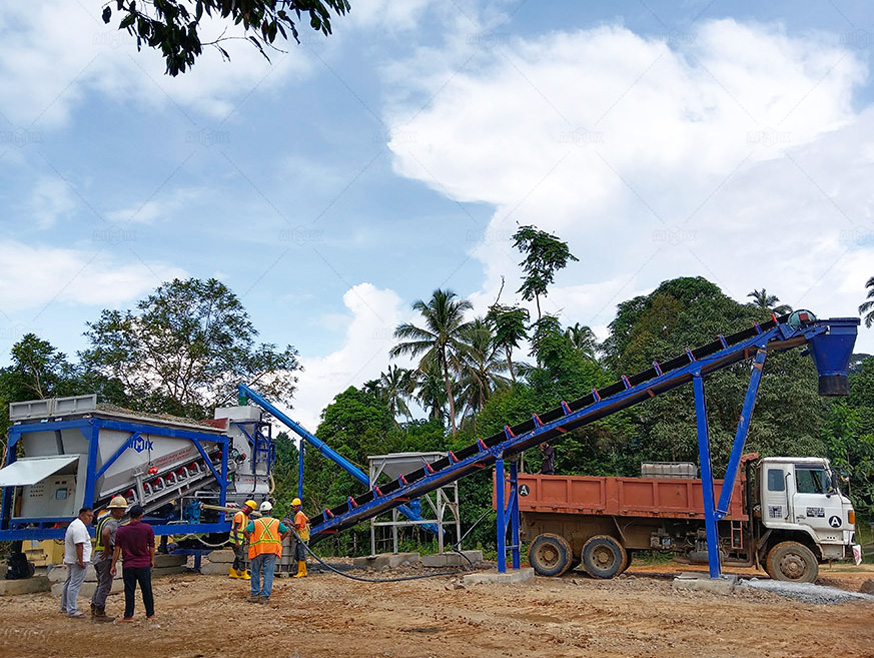
For buyers procuring portable batching plants from international manufacturers — a majority scenario given the dominance of Chinese and Indian suppliers across export markets — the gap between ex-works quotation and landed equipment cost represents a substantial and frequently underestimated financial exposure. Ocean freight charges from Shanghai, Qingdao, or Mumbai to destination ports in Africa, Latin America, or Southeast Asia vary considerably with vessel capacity, routing, and seasonal demand fluctuations, but routinely add 8 to 18 percent to ex-works equipment value. Import duties, where applicable, layer further cost upon arrival. Port handling, customs agency fees, terminal handling charges, and inland haulage from port to project site collectively contribute an additional cost stratum that unsophisticated buyers fail to budget for adequately. A quotation presented as CIF or even CFR shifts some of this burden, but FOB and ex-works quotations — common in initial supplier communications — transfer the entirety of these logistics costs to the buyer, a transfer whose magnitude only becomes apparent when freight forwarder invoices arrive.
Hidden Costs Within Warranty and After-Sales Provisions
Warranty Exclusions and the True Scope of Coverage
Warranty provisions in low-cost portable batching plant quotations deserve meticulous scrutiny. A stated warranty period of twelve or twenty-four months may appear reassuring in isolation, but the substantive protection it affords depends entirely on its exclusion clauses — provisions that are rarely foregrounded in quotation documents and frequently require deliberate extraction from embedded contractual terms. Common exclusions encountered in budget-tier equipment warranties encompass wear components including mixer blades, drum liners, conveyor belts, and sealing assemblies — precisely the components that experience the earliest and most frequent failure under sustained production loading. Additional exclusions may void warranty coverage for equipment operated outside narrowly defined ambient temperature ranges, subjected to aggregate specifications deviating from manufacturer recommendations, or maintained using non-OEM spare parts. When these exclusions are aggregated, the practical warranty coverage offered may be substantially narrower than the headline warranty period implies, leaving buyers financially exposed to early-life component failures that a genuinely comprehensive warranty would have remediated at manufacturer expense.
Spare Parts Pricing, Availability, and Long-Term Support Costs
The initial equipment acquisition cost represents only the first chapter of a portable batching plant's financial narrative. Spare parts procurement, maintenance consumables, and technical support engagements constitute a recurrent expenditure stream that extends across the plant's entire operational lifespan — typically eight to fifteen years for quality-tier equipment. Budget-oriented manufacturers frequently adopt a pricing strategy that subsidises headline equipment pricing through elevated spare parts margins, a model that transfers cost from the visible pre-purchase phase to the less visible post-purchase operational phase. Buyers who negotiate aggressively on equipment price without investigating spare parts pricing structures may discover that their apparent procurement success has been achieved at the expense of elevated long-term operating costs. Critical wear components — particularly those proprietary to a specific manufacturer's non-standard designs — can command pricing premiums of 40 to 150 percent above market equivalents for standardised components, with limited competitive alternatives available given the proprietary specifications involved.

Commissioning, Training, and Installation Costs Often Left Unstated
The True Cost of Getting the Plant Operational
A portable concrete batching plant delivered to site is not a plant ready to produce concrete. Commissioning — encompassing mechanical assembly verification, hydraulic circuit pressure testing, electrical system certification, weigh batcher calibration, control system configuration, and trial batch production — represents a distinct professional service activity whose cost is frequently absent from initial quotations. Manufacturers offering the lowest equipment prices commonly provide commissioning support under separately negotiated service agreements, the pricing of which only becomes apparent after the equipment purchase commitment has been made. International travel costs for factory commissioning engineers, accommodation, subsistence, and per-diem charges can add USD 5,000 to USD 20,000 to total project costs depending on site location and commissioning duration — an expenditure that buyers operating on tight capital budgets may find acutely uncomfortable when encountered as a post-commitment surprise rather than a pre-commitment budget line.
Operator Training Deficiencies and Their Downstream Cost Consequences
Inadequate operator training represents a fine-print omission whose financial consequences manifest not as a discrete invoice but as a diffuse pattern of operational underperformance, accelerated component wear, and avoidable equipment damage extending across the small concrete batch plant's service life. Budget quotations that include nominal training provisions — a single day of on-site demonstration, or a factory visit of insufficient depth — leave operators without the technical competence to optimise mix design parameters, recognise early-warning mechanical symptoms, execute correct shutdown procedures, or perform preventive maintenance to manufacturer specification. The downstream costs of this knowledge deficit accumulate quietly but persistently: suboptimal concrete quality generating structural remediation expenses, premature wear component replacement driven by incorrect operational practices, and unplanned downtime resulting from minor faults that a competently trained operator would have intercepted before escalation. The lesson embedded within every deceptively low portable batching plant quotation is consistent and unambiguous: total cost transparency, demanded before commitment, is the only reliable safeguard against the financial disappointments that fine print is specifically structured to obscure.


