Construction without Limits: The Role of Portable Batching Plants in Hard-to-Reach Locations
The conventional model of construction logistics operates on a hub-and-spoke principle, relying on a fixed concrete plant feeding a fleet of transit mixers that navigate a radiating network of roads. This system fractures completely when confronted with true geographic extremity—the remote mountain pass, the isolated island development, the environmentally sensitive wetland, or the densely packed urban canyon with no truck access. In these landscapes, the very premise of delivered ready-mix concrete becomes a prohibitive, often impossible, constraint. This is the operational domain where portable concrete plants cease to be merely convenient equipment and become the fundamental enabler of construction itself. They represent a paradigm shift from transported material to transported production capability, dissolving traditional geographic and logistical barriers to establish a foothold of industry in the most recalcitrant locations.
Conquering Geographic Inaccessibility: Redefining the Supply Chain
The primary and most profound role of the portable plant is its dismantling of unsustainable supply lines. In hard-to-reach locations, every kilometer of transport for perishable concrete carries exponential cost and risk.

Eliminating the Tyranny of Distance and Terrain
Consider a hydroelectric dam project in a rugged alpine valley. A standard transit mixer journey from the nearest fixed plant could involve hours on precarious roads, leading to guaranteed slump loss, material segregation, and a total failure of quality control. The economic weight of fuel, driver time, and vehicle wear is crushing. A mobile concrete batching plant, deployed directly within the project’s epicenter, obliterates this vulnerable supply chain. Raw materials—aggregate, cement, water—can often be sourced locally or brought in via more efficient bulk transport, not as time-sensitive slurry. The plant itself becomes the local hub, a micro-industrial outpost that generates concrete within minutes of its final placement. This is not an optimization of logistics; it is a complete topological redesign of production.
The On-Site Production Imperative
Furthermore, many sites are not just distant—they are physically inaccessible to large delivery vehicles. A bridge replacement project in a constrained historical district, a wildlife observation platform in a protected forest, or a mining operation along a single-lane haul road cannot accommodate the constant comings and goings of mixer trucks. The noise, congestion, and sheer spatial imposition are unacceptable. A compact, portable plant can be positioned in a designated, contained area on-site, producing material that is then moved via mini-dumpers, pumps, or conveyors over the final short distance. This solves the last-mile problem that is otherwise insurmountable, turning an impossibility into a managed, contained process.
The Engineering of Autonomy: Systems for Self-Sufficiency
A portable plant in a remote location cannot function as a mere scaled-down version of its urban counterpart. It must be engineered as a self-sufficient system, designed for operational sovereignty in a resource-constrained environment.
Integrated Logistics and Material Sovereignty
True portability encompasses the entire material workflow. Advanced units are designed with integrated feed systems, low-profile designs for easy unloading from transport, and configurations that minimize ground preparation. Crucially, they are planned with local material procurement in mind. A sophisticated portable setup will include screening and washing attachments to process locally quarried or excavated aggregate, reducing dependency on imported, graded material. Water recycling systems become non-negotiable, closing the loop on the most precious resource in arid or remote sites. This integrated design philosophy transforms the plant from a consumer of a prepared supply chain into the active manager of a localized, resilient one.
Configurational Flexibility for Precise Site Demands
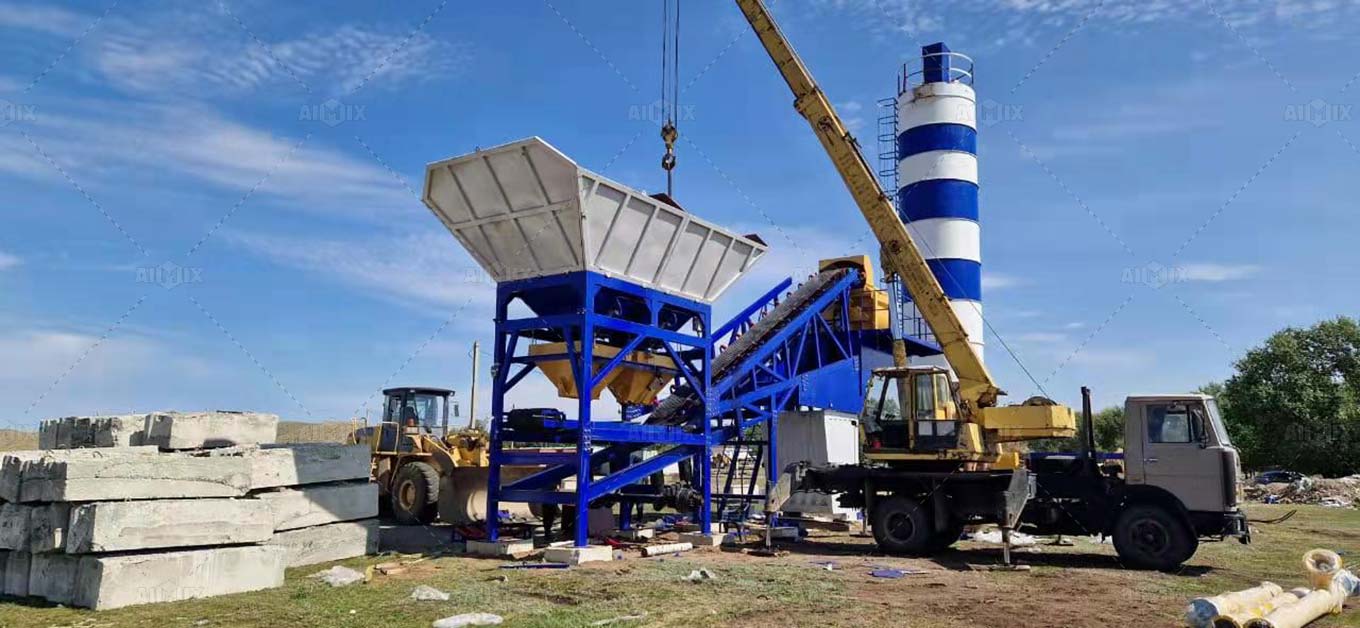
The term "portable" is not monolithic. It encompasses a spectrum from towable units behind a truck to modular systems containerized for airlift or barge transport. This configurational flexibility is a critical strategic tool. For an island resort project, plant modules can be shipped in standard containers. For a remote highway project through a desert, a fully towable train of components can be hauled by road. The plant can be sized and specified precisely for the project’s peak demand, avoiding the colossal overcapacity of a temporary stationary concrete plant. This precise matching of capability to need is a hallmark of efficient remote project execution, preventing capital from being idled in an unforgiving environment.
Strategic Advantages Beyond Mere Placement
The benefits of deploying portable batching plants in hard-to-reach locations extend far beyond solving the basic problem of access. They confer deep strategic advantages that redefine project economics and management.
The Economic Calculus of Remote Production
While the capital cost of a portable plant is a factor, the total project economics often tell a different story. The elimination of hundreds or thousands of long-distance concrete truck journeys slashes direct costs for fuel, maintenance, and driver wages. It dramatically reduces the carbon footprint of the project—a critical metric for modern environmental compliance. More subtly, it insulates the project from the volatility of external supply. You are no longer subject to the pricing, scheduling, or quality inconsistencies of a third-party ready-mix supplier located hours away. This control translates into predictable costs and a stabilized budget, a priceless advantage in complex projects.
Accelerated Timelines and Risk Mitigation
Time compounds risk in remote locations. Weather windows are narrow, and delays are magnified. A portable plant accelerates the project tempo by decoupling production from distant variables. Concrete pours can proceed on the project’s schedule, not on a timetable dictated by truck arrival from a distant plant. This allows for more aggressive sequencing, better crew utilization, and the ability to capitalize on favorable conditions immediately. Moreover, it mitigates catastrophic risk. A landslide blocking the only access road or a breakdown in a remote transit mixer becomes a crisis. A local plant, with its stockpiles of raw materials, provides a buffer against such external shocks, ensuring that critical path activities can continue unabated. In essence, the portable batching plant does not just enable construction in hard-to-reach places; it secures it, providing the logistical autonomy and predictable control that turns a high-risk venture into a manageable, executable plan.


